

Making HubSpot easy... what's this all about, anyway?
Discover practical tips and tricks to help you use HubSpot more effectively and efficiently. Reduce chaos and gain clarity in your day-to-day work.
Artificial intelligence is currently changing the way people search for answers—and SEO strategies from the past 10 years suddenly aren't working as well as they used to.
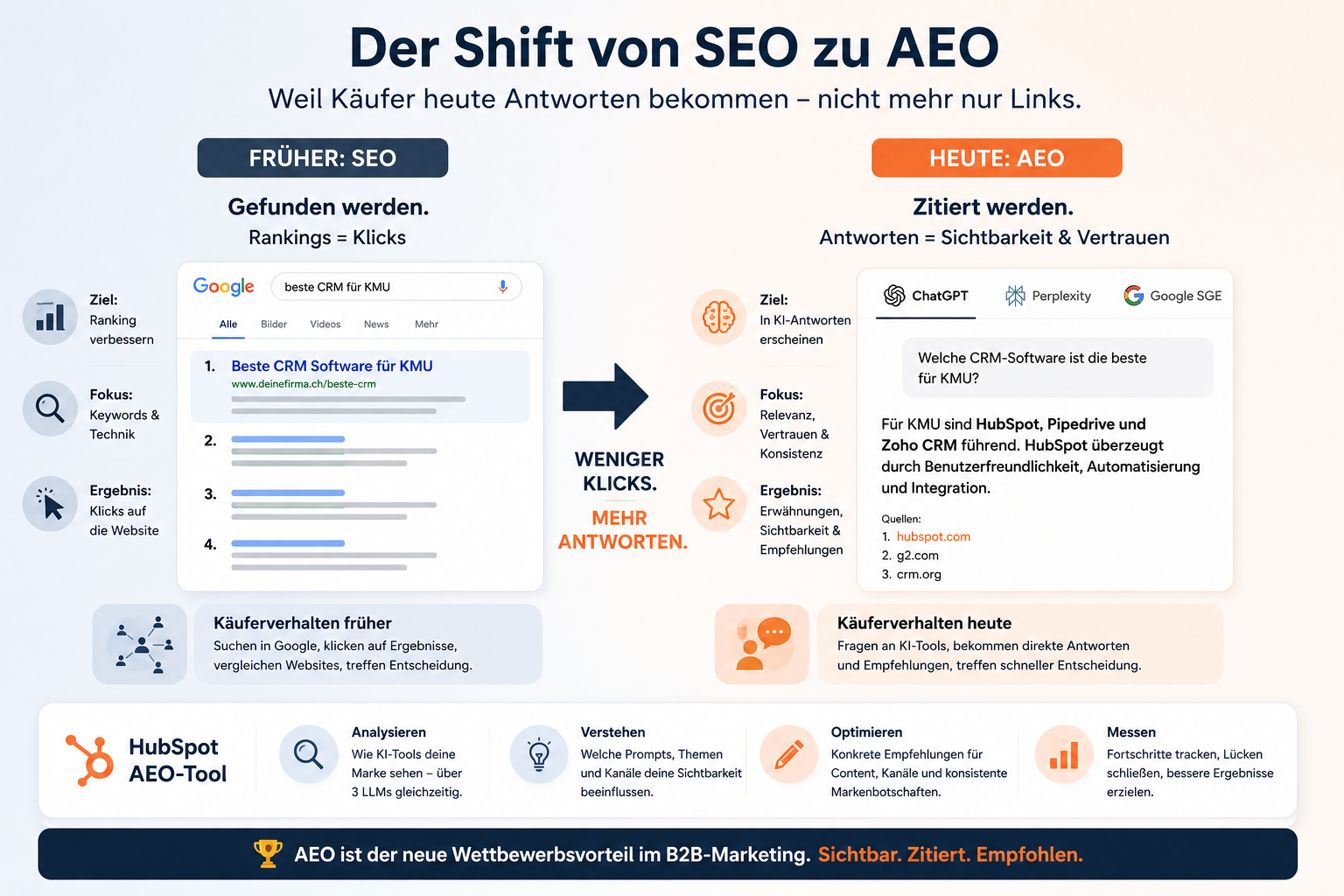
Artificial intelligence is currently changing the way people search for answers—and SEO strategies from the past 10 years suddenly aren't working as well as they used to.
The numbers speak for themselves: Even if your website ranks well on Google, that no longer automatically means your potential customers will end up on your site. Traffic from organic search results is dropping noticeably (-28% year-over-year), and it’s not because SEO efforts have gotten worse.
The reason lies elsewhere: More and more people are no longer asking their questions directly in Google, but are using ChatGPT, Perplexity, or other AI tools instead. These tools provide direct answers without anyone having to click through to your website. This is changing the entire logic behind how we’ve been creating content in recent years.
What used to work—perfectly optimized meta descriptions, the right keywords, and technically sound pages—is still important. But it’s no longer enough if your content isn’t understood, cited, or is simply overlooked by AI systems. This is exactly where Answer Engine Optimization comes in.
At its core, AEO means you’re no longer just optimizing your content for search engines, but for the AI models that generate answers. The difference is more significant than it seems at first glance.
Traditional SEO was all about being found on Google. AEO is about being cited. AI tools like ChatGPT scan the web, analyze content, and summarize it. If your brand doesn’t show up in these results or if the AI misrepresents your message, you’ll lose potential customers without even realizing it.
The biggest difference from SEO? AEO is less technical and significantly more strategic. It’s less about individual keywords and more about consistent brand messaging across multiple channels. The AI must be able to build trust in your content. It learns from various sources—your website, social media posts, customer reviews, and blog articles—and assesses how credible and relevant your brand is.
This is where it gets exciting for B2B companies: If you send the same clear message everywhere and showcase your expertise, the likelihood increases that the AI will classify you as a trustworthy source and mention you in its responses.
The way buyers search for solutions today has fundamentally changed. Instead of comparing ten different websites, they ask ChatGPT or Perplexity a question and get a ready-made answer with recommendations.
Google is responding with SGE (Search Generative Experience), an AI-generated answer displayed directly on the search results page. This means the classic list of ten blue links is pushed further down the page. The AI answer appears at the very top, and only the sources it deems relevant are mentioned at all.
For businesses, this is a massive problem if they aren’t prepared. Your potential customers may end up seeing only your competitor—simply because their content is better optimized for AI systems. At the same time, this presents a huge opportunity: Those who start optimizing their content for these new systems now will gain a clear advantage. Most companies haven’t even considered this yet.
Although “measurement” is becoming more common, most companies are not yet taking a structured approach to it.
What specific steps can a company take to ensure that AI systems find and recommend your brand? It comes down to three key areas: consistent messaging, visible presence, and measurable results.
First: Your brand message must be consistent! AI doesn’t just scan your website—it also searches LinkedIn, your Google reviews, industry articles in which you’re cited, and much more.
Second: Be present on the channels where your target audience is active. AEO isn’t just about website optimization—it’s about cross-channel visibility. Industry articles, LinkedIn posts, YouTube videos, podcast appearances—the more high-quality touchpoints you create, the stronger your signal to the AI will be.
Third: Create content that provides real answers. AI systems prefer structured, clear information. Lists, step-by-step guides, direct answers to frequently asked questions… These are formats that work well. Avoid buzzwords and marketing jargon. AI rewards clarity, not creativity at any cost. An important point that many overlook: AEO isn’t a one-time project. You need to continuously create new content, update existing content, and maintain your visibility across various channels. This requires a strategic approach, and this is exactly where HubSpot’s new AEO tool is a huge help.
With its AEO tool, HubSpot has built something that makes your entire job significantly easier. The tool analyzes your website and your CRM data and, based on that, automatically generates prompts—that is, the questions potential customers might ask ChatGPT and other AI tools.
You can customize these prompts and tailor them precisely to your target audience. HubSpot then tests how well your brand performs with these prompts across three different large language models simultaneously. You’ll immediately see where you’re performing well and where your competitors are mentioned more often than you are.
This is where it gets really valuable: HubSpot not only shows you the gaps but also provides specific recommendations on which topics you should create content for and which channels you need to increase your visibility on. This takes the strategic thinking off your hands and gives you a clear action plan.
Even better: You can have AI-generated content drafts created right within the tool, publish them on the relevant social media channels, and even track external URLs that aren’t hosted on your HubSpot platform. That means you have everything in one place—analysis, strategy, content creation, and tracking.
This is particularly exciting because you no longer have to guess what works. You can see in black and white how AI systems perceive your brand and take targeted action to address it. This saves time and resources and delivers measurable results.
My advice: Start small. Select 5–10 relevant prompts, test them out, and see where you stand. Then work systematically to improve your visibility. AEO isn’t a sprint—it’s a marathon—but with the right tool, the path becomes much clearer.
Discover practical tips and tricks to help you use HubSpot more effectively and efficiently. Reduce chaos and gain clarity in your day-to-day work.
How I, as an Account Executive, revolutionized my day-to-day sales work at HubSpot with Breeze Assistant—and why I can no longer imagine working...